


A multi-LLM architecture is a system design that enables an organization to use multiple large language models simultaneously based on task type, rather than relying on a single model. Through model routing, observability, and fallback mechanisms, each query is directed to the most suitable model for that specific workload. The goal is to reduce vendor lock-in, optimize costs, and improve accuracy.
Organizations are no longer tethered to a single AI provider. Different tasks are better solved by different models, and this shift brings architectural decisions with it. However, this transition should not be random; it must be based on specific triggers and metrics. In this article, we explore what a multi-LLM architecture is, what components it consists of, and when it makes sense for your organization.
What is a Multi-LLM Architecture?
Multi- LLM architecture is a system structure where an application can access multiple models rather than just one, allowing for task-based selection between them. This structure includes a routing layer, a model catalog, and typically an observability mechanism.
This concept is often confused with two other approaches. Multi-agent systems refer to multiple AI agents specializing in specific tasks and working in coordination with one another, where the emphasis is on task division and inter-agent communication. Multimodal systems, on the other hand, describe a single model's ability to process different data types—such as text, images, and audio—simultaneously. Unlike these, a multi-LLM architecture is a selection and routing problem regarding which task should go to which model.
In practice, these three approaches can coexist within the same system. An enterprise application can utilize multi-model routing, multimodal input processing, and agent-based workflows. However, each requires a distinct architectural decision and they are not interchangeable.
Why Do Organizations Use Multiple Models Instead of a Single LLM?
The single-model approach seems simple, but it becomes limiting as you scale. Organizations are moving toward a multi-model strategy for four primary reasons: cost optimization, task-based accuracy, reduction of vendor lock-in, and latency management.
In terms of cost, using the most expensive and powerful model for every query is inefficient. Tasks requiring simple classification or short responses can be solved with smaller, cheaper models, while tasks requiring complex analysis or multi-step reasoning can be routed to more powerful models. This distinction significantly lowers the total cost of ownership.
Regarding accuracy, models have different areas of strength. One model may excel at code generation, while another may perform better at long-context analysis or multilingual tasks. According to current market research, approximately 55% to 65% of organizations now run multiple leading models in production simultaneously rather than relying on a single provider.
Vendor lock-in is also becoming an increasingly critical issue. An architecture dependent on a single model remains vulnerable to that provider's price changes, service outages, or policy shifts. A multi-model approach distributes this risk and provides flexibility for migration.
What Components Make Up a Multi-LLM Architecture?
A multi-LLM architecture typically consists of four layers: model routing, a gateway/API layer, observability, and a fallback mechanism. The model routing layer analyzes each incoming request and forwards it to the appropriate model. The gateway layer centralizes authentication, usage tracking, and billing. The observability layer monitors performance and cost metrics. The fallback mechanism automatically redirects a request to an alternative model if one becomes unavailable.
Choosing a routing strategy is one of the most critical architectural decisions. The advantages and disadvantages of different approaches can be summarized as follows:
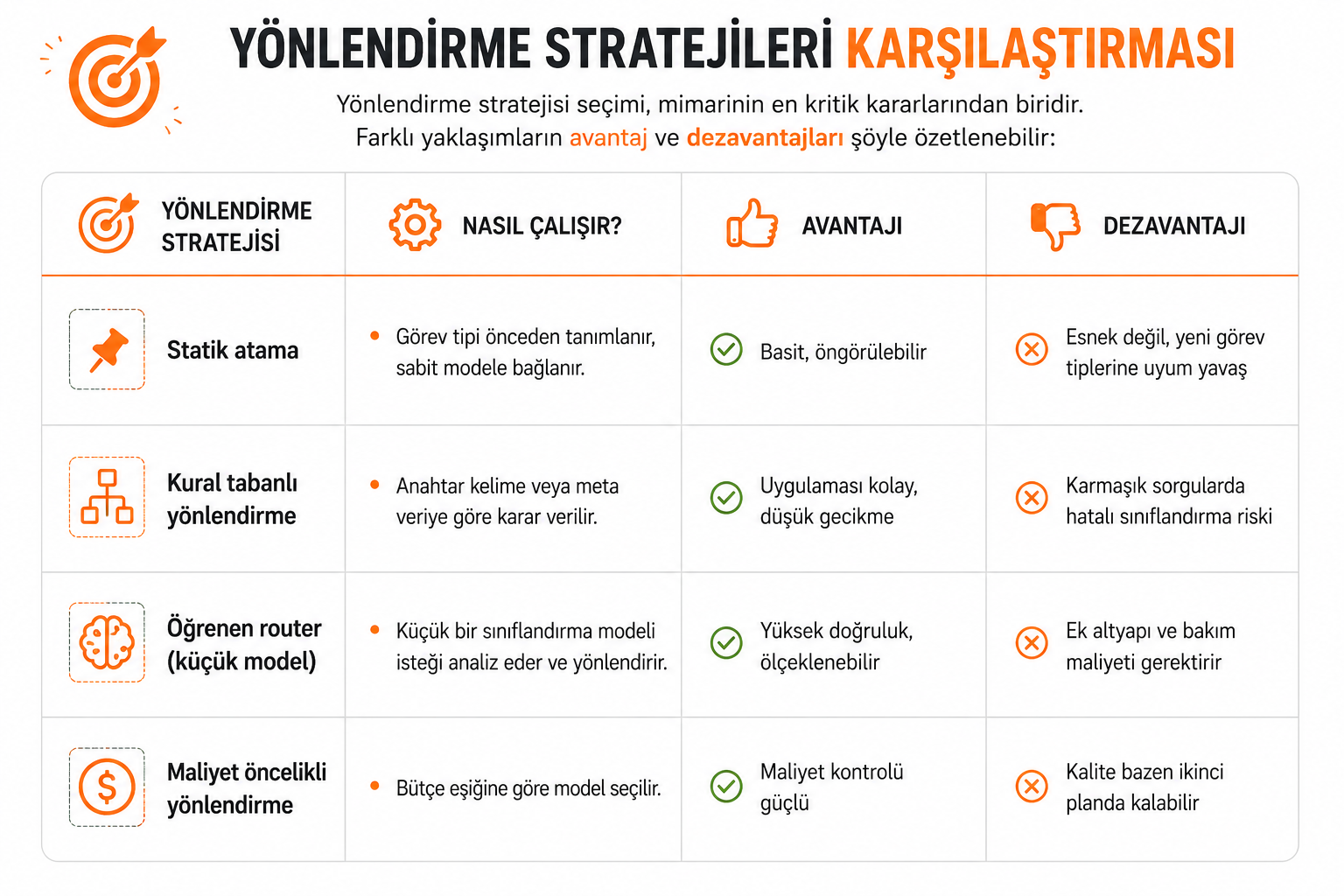
Most organizations transition from a rule-based approach to a learning router model as they scale. This shift usually occurs when query volume exceeds a certain threshold and manual rule maintenance becomes unsustainable.
When Should You Choose a Single Model vs. a Multi-Model Approach?
Not every organization needs a multi-LLM architecture. The decision depends on workload diversity, query volume, and compliance requirements. A single model is often sufficient and less complex for low-volume, uniform tasks.
The following criteria can guide your decision-making process. If your application involves three or more different task types (e.g., short responses, code generation, long document analysis), a multi-model architecture becomes sensible in terms of cost and accuracy. If your monthly query volume exceeds a certain threshold, the cost pressure on a single model becomes significant, making model diversification necessary. If regulatory compliance or data residency requirements mandate different models for specific tasks, a multi-model approach becomes a necessity rather than a choice.
Conversely, for small-scale applications involving low-volume, uniform tasks, the operational complexity introduced by a multi-model architecture may outweigh its benefits. In such cases, starting with a single model and expanding the architecture as volume grows is a more logical approach.
How to Implement a Multi-LLM Architecture in Enterprise Data and Analytics Workloads?
In the context of enterprise data analytics, multi-LLM architecture finds concrete applications. In the natural language querying (NLQ) layer, the task of converting a user's free-text question into a structured query can often be handled by a faster, lower-cost model, while interpreting the results within a business context and turning them into a narrative may require a more powerful reasoning model.
In systems operating on a semantic layer, this step is typically directed toward a higher-accuracy model, as the correct interpretation of metric definitions and business rules is critical. In contrast, repetitive tasks such as automated report summarization or notification text generation can be efficiently handled by lighter models.
In agent-based data analysis scenarios, multi-LLM architecture often works in tandem with multi-agent structures. While one agent performs data discovery, another may take on validation or reporting tasks; each agent uses the model best suited to its task profile. This layered approach offers a more scalable structure than burdening a single model with the entire workload.
What Are the Risks and Governance Requirements of Multi-LLM Architecture?
While a multi-model architecture provides benefits, it also introduces new risks. The greatest risk is a loss of consistency. Different models may respond to the same question in different ways or with varying quality, which can lead to fluctuations in user experience and result reliability.
Concerns about accuracy are at the heart of this risk. In recent enterprise surveys, 74% of organizations artificial intelligence systems cite the risk of inaccuracy as their primary concern, an increase of 14 percentage points from the previous year. In a multi-model environment, this risk can become even more pronounced due to inconsistencies between models.
To manage these risks, investments in observability and explainability are becoming mandatory. Furthermore, a centralized model catalog, a clear cost-tracking mechanism, and regular model performance audits are essential governance elements for the sustainable operation of a multi-LLM architecture. Since this is a rapidly evolving field, the model catalog and routing rules should be reviewed on a quarterly basis.
Frequently Asked Questions
Does a multi-LLM architecture increase or decrease costs?When implemented correctly, it reduces costs because simple tasks are routed to inexpensive models and complex tasks to expensive ones. However, if the routing logic is flawed, unnecessary model diversity can increase costs.
Is a multi-LLM architecture necessary for small teams?Generally, no. For small-scale applications with low-volume and uniform tasks, a single model is sufficient and imposes less operational burden.
Are multi-LLM architecture and multi-agent architecture the same thing?No. Multi-LLM architecture is a routing problem that decides which model should handle which task; multi-agent architecture involves multiple AI agents working in coordination by dividing tasks among themselves. The two can also be used together.
How is data privacy maintained in a multi-LLM architecture?A centralized gateway layer ensures privacy control by logging which data is sent to which model and, when necessary, excluding specific models from certain data classes. This is particularly important for organizations with regulatory compliance requirements.
TL;DR
- A multi-LLM architecture is a system design that routes different tasks to different models, distinct from multi-agent and multimodal systems.
- Approximately 55-65% of enterprises are now using multiple leading models in production simultaneously.
- Four core components: model routing, gateway, observability, and fallback mechanism.
- Decision criteria: task diversity, query volume, and compliance requirements.
- Enterprise data analytics requires different model profiles for NLQ, semantic layers, and agent-based analysis.
- The greatest risks are loss of consistency and accuracy control; observability and centralized governance are essential.
Conclusion
Multi-LLM architecture is no longer an experimental approach but is becoming a standard component of scalable enterprise AI systems. However, this transition is not an automatic upgrade; it is a deliberate architectural decision based on workload diversity, volume, and compliance requirements.
Start by classifying your organization's current LLM use cases by task type; identify which tasks could benefit from different model profiles and design a pilot routing layer based on this analysis.
Resources:
- Presenc AI, Enterprise LLM Adoption Statistics (compilation of survey data from McKinsey, BCG, Gartner, Deloitte, IBM 2026), June 2026
İlginizi Çekebilecek Diğer İçeriklerimiz
A multi-LLM architecture is a system design that enables an organization to use multiple large language models simultaneously based on task type, rather than relying on a single model. Through model routing, observability, and fallback mechanisms, each query is directed to the most suitable model for that specific workload. The goal is to reduce vendor lock-in, optimize costs, and improve accuracy.
NaaS (Network as a Service) is a service model where businesses lease network services from a cloud provider via a subscription, rather than purchasing and managing their own network hardware. Functions such as firewalls, load balancing, VPNs, and WAN connectivity are delivered through software instead of hardware. This model transforms capital expenditure into operating expenses, making network infrastructure more agile and scalable.


