


NaaS (Network as a Service) is a service model where businesses rent network services from a cloud provider via a subscription instead of purchasing and managing their own network hardware. Functions such as firewalls, load balancing, VPNs, and WAN connectivity are delivered via software rather than hardware. This model transforms capital expenditure into operating expenses, making network infrastructure focused on agility and scalability.
IntroductionHybrid work models, multi-cloud usage, and increasing data traffic between branches are rendering traditional network architectures inadequate. MPLS connections and hardware-based security devices are both expensive and slow to scale. NaaS offers a solution to these problems with a software-defined approach and is increasingly finding its place in the network strategies of many businesses. In this article, we discuss what NaaS is, which businesses it makes sense for, and what to consider during the transition process.
What is NaaS and How Does It Differ from Traditional Network Infrastructure?
NaaS is a service model where network functions are delivered as software via the cloud. Instead of buying hardware, businesses rent the network capacity they need from a provider.
In the traditional model, each branch sets up its own firewall, load balancer, and MPLS connection, which requires high capital investment and constant maintenance. With NaaS, companies can run their networks using only an internet connection without installing any hardware, replacing VPNs, MPLS connections, or other legacy network configurations.
This difference is particularly decisive for multi-branch businesses. NaaS is a structure where network infrastructure components—hardware, software, services, management, and licensing—are provided through a subscription-based or flexible consumption model. In other words, payment is based on usage rather than capacity.
Another important point is that NaaS can cover not only connectivity but also security functions. Firewalls, DDoS protection, and access control are usually offered within the same subscription. This reduces the burden on IT teams to integrate separate security solutions.
For Which Businesses is NaaS a Logical Model?
NaaS does not provide the same level of benefit for every business. Three criteria stand out when making a decision: the number of branches, the depreciation status of existing infrastructure investments, and the rate of growth.
Businesses with multiple branches or those that are geographically dispersed see the fastest benefits from NaaS. Connecting each new location to the provider's nearest point of presence is much faster than setting up a new MPLS line. This is a direct time advantage, especially for companies that are growing rapidly or opening branches frequently.
For businesses whose existing hardware investments have not yet been fully depreciated, the transition should be planned more carefully. Disposing of a fleet of firewalls or routers before their depreciation period ends can reduce the expected cost advantage from the start. In this case, a phased transition—for example, using NaaS only in newly opened branches—is a more rational starting point.
Businesses with high growth rates and unpredictable demand also benefit strongly from NaaS. Since capacity increases are made via subscription upgrades rather than purchases, demand fluctuations can be met without waiting for hardware lead times.
Conversely, for businesses with a single location, low growth rates, and existing infrastructure that does not require new investment, the return on NaaS may be more limited. For businesses with this profile, the decision should primarily be based on the operational ease provided by the security bundle.
What is the Difference Between NaaS and Traditional Network Infrastructure?
The table below summarizes the key differences between the two models.
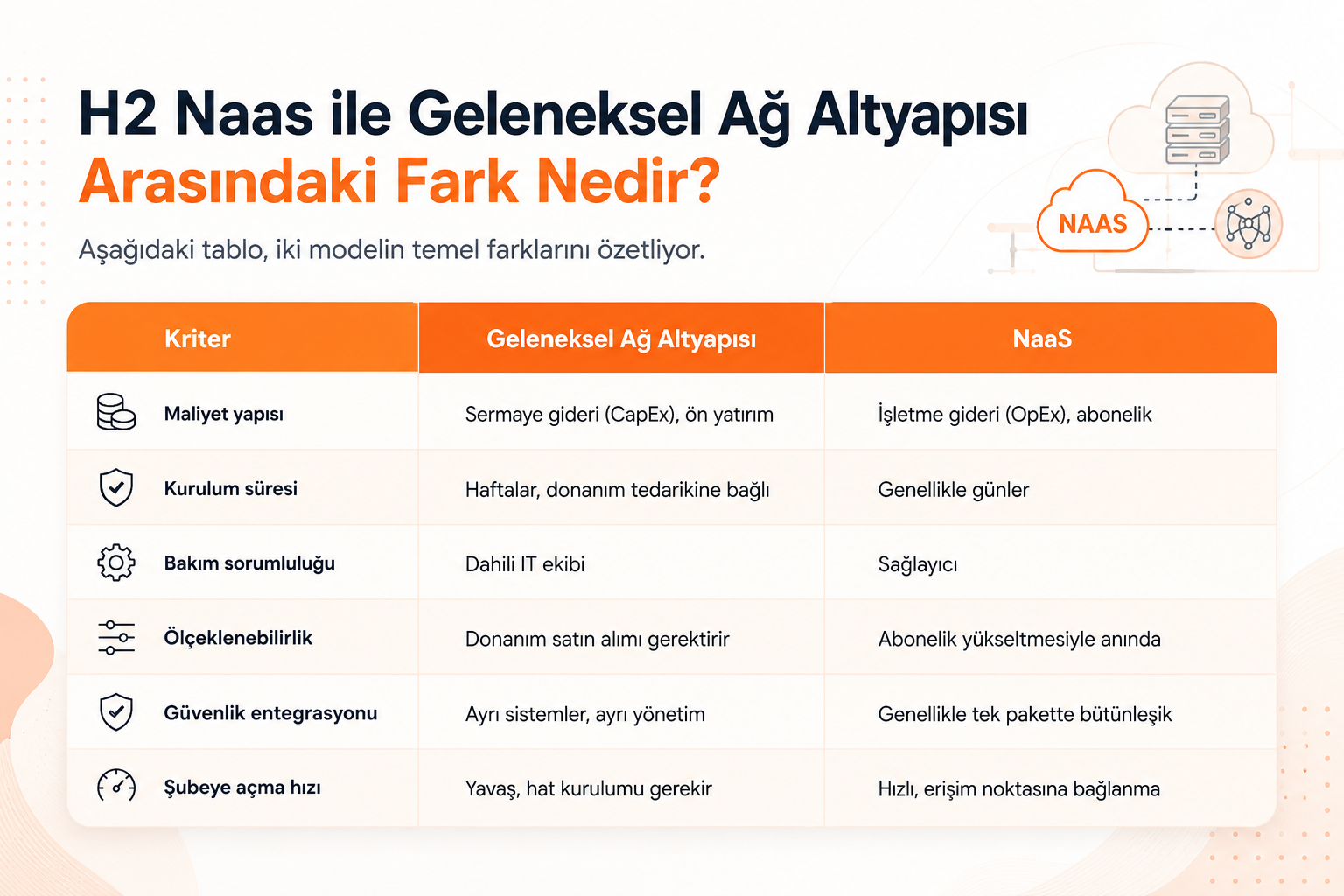
The most critical difference in the table is seen in the cost structure. While the traditional model requires capital expenditures for physical networks such as switches, routers, and licensing, NaaS shifts these costs to a flexible consumption model. This change directly affects cash flow management and provides an advantage, especially for mid-sized businesses with capital constraints.
What Challenges Are Encountered When Transitioning to NaaS?
The advantages of NaaS do not eliminate the risks in the transition process. Three challenges appear regularly.
Compatibility issues are the primary concern. The provider's infrastructure may not be fully compatible with existing legacy hardware or on-premises applications. This necessitates a detailed inventory and compatibility analysis before migration.
The second challenge arises when critical workloads are still running in on-premises data centers. In such hybrid infrastructures, migration requires more planning than a full cloud transition and usually follows a phased roadmap.
The third and most strategic risk is vendor lock-in. Becoming overly dependent on a single provider leaves the business vulnerable to price hikes or service outages. The most concrete way to mitigate this risk is to clearly define data portability and exit conditions during the contract phase.
How to Evaluate and Select NaaS?
When choosing a NaaS provider, you should use concrete criteria that go beyond marketing materials.
SLA terms are the first checkpoint. Uptime commitments, compensation clauses, and support response times must be clearly stated in the contract. Vague SLA language leaves a business unprotected during a crisis.
Integration capacity with existing systems is the second criterion. The provider's API support, compatibility with current authentication systems, and the usability of reporting tools directly determine the operational burden after migration.
The scope of the security bundle is the third criterion. Whether firewall and DDoS protection are included in the subscription or come at an extra cost should not be overlooked when calculating the total cost of ownership.
Finally, exit and data portability conditions must be clarified. The timeframe and format in which data and configurations can be migrated if a provider change is needed should be confirmed in writing before signing the contract.
Frequently Asked Questions
What is the difference between NaaS and SASE? NaaS delivers network functions as a service via the cloud. SASE is a broader architecture that combines software-defined networking with comprehensive security functions such as zero-trust access and secure web gateways. NaaS can be considered a subset that forms the networking component of SASE.
How is NaaS cost calculated? Costs are generally determined by bandwidth usage, the number of active users, and the scope of included security services. Since there is no fixed hardware investment, costs shift from capital expenditure (CapEx) to operational expenditure (OpEx). When evaluating total cost, the depreciation period of existing hardware should also be taken into account.
Does migrating to NaaS also cover security services? Most NaaS providers include firewall, DDoS protection, and access control in their subscriptions. However, the scope varies by provider, so it should be clarified before signing whether security components are billed separately. Some providers include basic security while offering advanced threat protection as an add-on package.
How long does it take to migrate to NaaS? Migration time varies depending on the complexity of the existing infrastructure and the number of branches. While it can be completed in a few weeks for single-location businesses with limited integration needs, the process can span months for businesses with multiple branches or hybrid infrastructures.
TL;DR
- NaaS is a model where network services are delivered via a cloud subscription rather than through hardware.
- It provides the greatest benefit for multi-branch, fast-growing businesses with unpredictable demand.
- The cost structure shifts from capital expenditure to operating expenditure, which directly impacts cash flow.
- Risks related to compliance, hybrid infrastructure, and vendor lock-in during the transition must be managed carefully.
- Provider selection should be based on SLAs, integration capacity, security bundles, and exit terms.
Conclusion
NaaS provides businesses with speed and scalability by transforming network infrastructure from a fixed capital investment into a flexible service model. However, this transformation is not an automatic win; it gains value only with the right business profile and the right provider selection. The depreciation status of current infrastructure investments, the rate of branch growth, and the risk of vendor lock-in should be at the heart of the decision to transition.
Evaluate whether NaaS is the right step at the right time for your business by comparing your current network infrastructure against the four criteria in this article: number of branches, depreciation status, growth rate, and security bundle requirements.
Resources:
İlginizi Çekebilecek Diğer İçeriklerimiz
A multi-LLM architecture is a system design that enables an organization to use multiple large language models simultaneously based on task type, rather than relying on a single model. Through model routing, observability, and fallback mechanisms, each query is directed to the most suitable model for that specific workload. The goal is to reduce vendor lock-in, optimize costs, and improve accuracy.
NaaS (Network as a Service) is a service model where businesses lease network services from a cloud provider via a subscription, rather than purchasing and managing their own network hardware. Functions such as firewalls, load balancing, VPNs, and WAN connectivity are delivered through software instead of hardware. This model transforms capital expenditure into operating expenses, making network infrastructure more agile and scalable.


