


Generative AI in enterprise data operates through an architecture known as RAG (Retrieval-Augmented Generation). In this approach, company documents are converted into numerical vectors and stored in a vector database. When a question is asked, the most relevant content is retrieved, and the language model generates its response based solely on these verified sources. The result is up-to-date, traceable, and hallucination-reduced answers without the need to retrain the model.
Enterprise AI conversations no longer revolve around "model selection." The real question has become: How do you transform the scattered data a company has accumulated over years into a system that produces reliable answers? The answer lies in the RAG and vector database duo. In this article, we will explain the data pipeline from raw document to verifiable answer step-by-step, compare which vector database suits which scenario, and address with concrete data why organizations frequently fail with these systems.
What are RAG and a vector database?
RAG is an architecture that allows a language model to retrieve relevant content from an external knowledge source before generating a response. A vector database is the infrastructure where this content is stored in a semantically searchable format. Together, they ensure the model "finds the source first and speaks later" instead of just "guessing."
A classic large language model (LLM) only knows the data it was trained on and cannot see anything beyond its training cutoff date. It cannot know the procedure your company published last week, the specific clause in a customer contract, or an internal policy document. RAG closes this gap. It sends only small text snippets relevant to the specific question to the model, rather than the entire database.
The difference with a vector database is that it performs searches based on meaning rather than keywords. A search for "annual recurring revenue" can find a document containing "ARR calculation" even if those exact words do not appear. This capability is something traditional relational databases cannot offer and forms the foundation of enterprise knowledge bases.
How does enterprise data turn into generative AI?
Enterprise data transforms into answers through a five-stage pipeline: chunking, embedding, storage, retrieval, and generation. Every link in this chain directly determines the quality of the final answer. RAG is not just a feature; it is this end-to-end pipeline itself.
The first stage is chunking. Long documents are divided into smaller pieces that maintain meaningful integrity. The size and boundaries of these chunks are critical; poor chunking that cuts a sentence in half disrupts all subsequent stages.
The second stage is embedding. Each text chunk is converted into a sequence of hundreds or thousands of numbers—a vector—via an embedding model. Semantically similar chunks are positioned close to each other in vector space. Choosing an embedding model is one of the least discussed decisions that directly impacts retrieval accuracy.
The third stage is storage. These vectors are stored in a vector database that uses ANN (Approximate Nearest Neighbor) indexes. This index structure makes it possible to find the most relevant items among millions of vectors in milliseconds.
The fourth stage is retrieval. The user's question is also converted into a vector, and the database returns the chunks closest to this vector. In the fifth and final stage, the generative model takes these chunks as context to create the response. Well-designed systems can cite the source document for the answer; this is essential for enterprise auditability.
Why choose RAG over an LLM?
RAG is the fastest way to add company-specific and up-to-date information without retraining the model. Fine-tuning and long context windows are alternative approaches, but they offer different cost and flexibility profiles. The right choice depends on how often the data changes and the need for traceability.
The comparison of the three approaches is as follows:
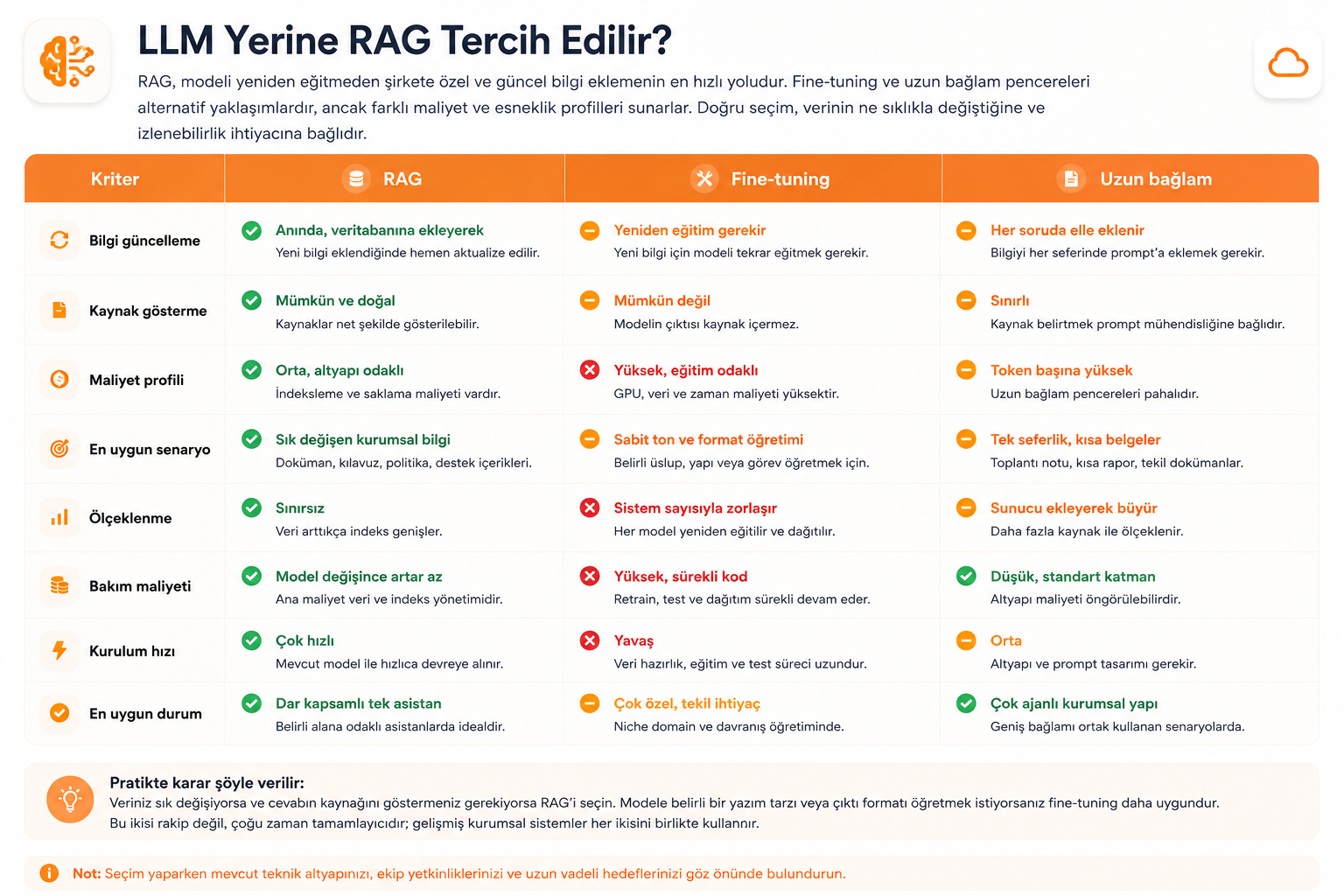
In practice, the decision is made as follows: If your data changes frequently and you need to show the source of the answer, choose RAG. If you want to teach the model a specific writing style or output format, fine-tuning is more appropriate. These two are not competitors; they are often complementary, and advanced enterprise systems use both together.
Which vector database is suitable for enterprise use?
There is no single "best" vector database for enterprise use; the choice depends on scale, hosting preferences, and existing infrastructure. As of late 2025, the market has largely concentrated around four players: Pinecone, Weaviate, Qdrant, and Milvus. pgvector is a pragmatic fifth option for those using existing PostgreSQL infrastructure.
Comparison of the main options:
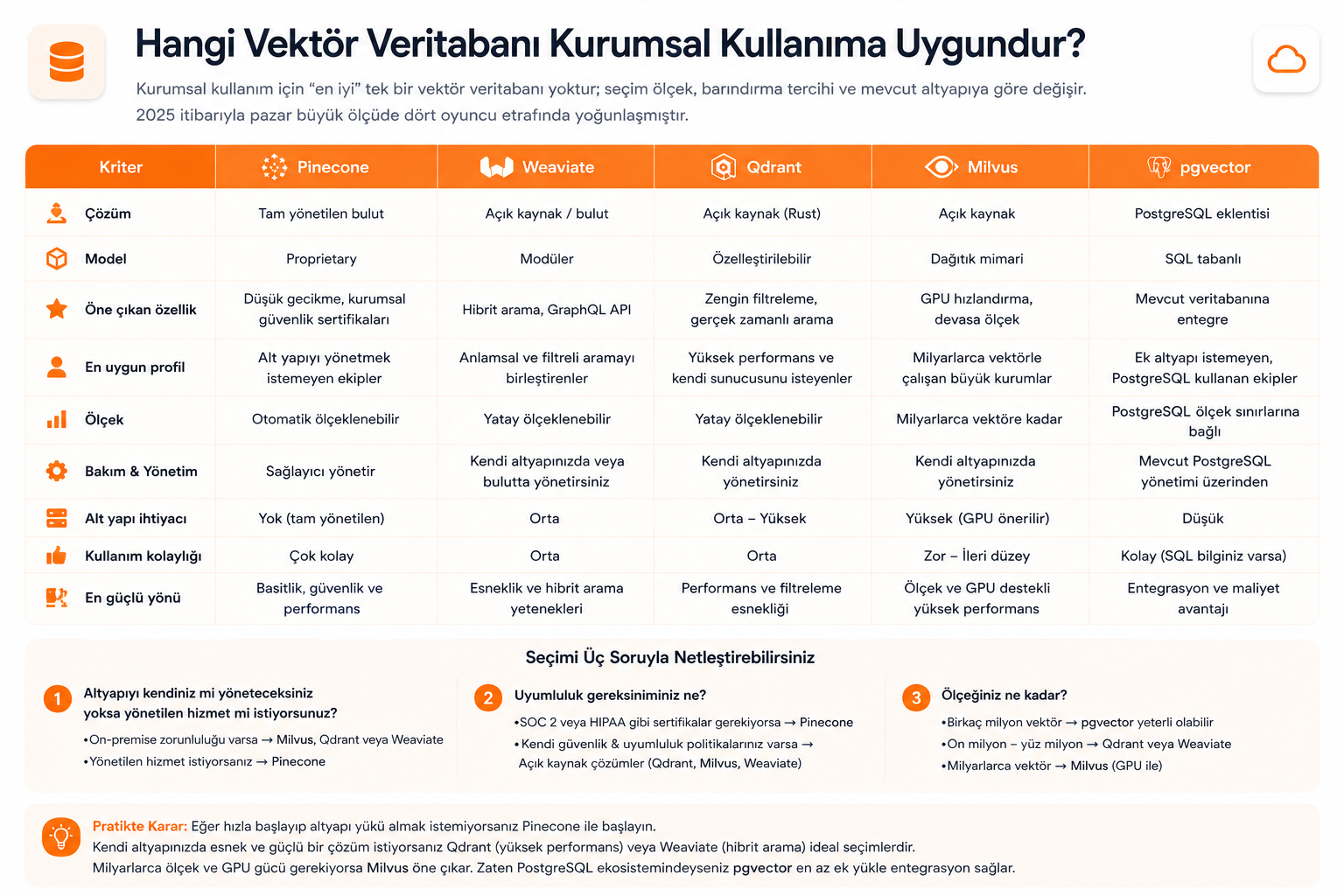
You can clarify your choice with three questions. First: Will you manage the infrastructure yourself, or do you want a managed service? If there is an on-premise requirement, Milvus, Qdrant, or Weaviate stand out. Second: What are your compliance requirements? If certifications like SOC 2 or HIPAA are needed, managed cloud options accelerate the process. Third: What is your scale? While pgvector is sufficient for a few million vectors, billions of vectors require GPU-accelerated solutions like Milvus.
Why does RAG fail at enterprise scale?
In most RAG projects, the bottleneck is not the model; it is data quality, retrieval design, and governance. While adoption is widespread, scaling is rare because organizations often optimize the wrong layer. This is the industry's least discussed but most defining truth.
The data clearly illustrates this trend. According to McKinsey's 2025 State of AI research, 88% of organizations regularly use AI in at least one business function; this rate was 78% in 2024. However, there is a deep chasm between adoption and value creation. The same research reveals that only about one-third of organizations have begun scaling AI across the enterprise. Investment is rising rapidly: enterprise generative AI spending has increased from $1.7 billion in 2023 to $37 billion in 2025.
The reason for this chasm is structural, not technical. A perfect model fed with garbage data will still produce garbage. Poor chunking, failure to clean up outdated documents, duplicate content, and weak embedding model selection silently break the retrieval stage. Most organizations look for the error in the model, whereas the problem is usually in the early links of the pipeline.
The second structural issue is governance. If it is not designed in advance who can see which document, how sensitive data will be masked, and how responses will be audited, trust issues arise when the system goes into production. Successful organizations treat RAG not as a model project, but as a data and process project.
When are Agentic RAG and GraphRAG needed?
Standard RAG settles for a single retrieval step; Agentic RAG and GraphRAG are developed for scenarios requiring more complex reasoning. These approaches are not necessary for every project, but they make a significant difference in multi-step queries. Since this section covers a rapidly evolving field, it is recommended to review it at least once a year.
Agentic RAG is an approach where the system does not settle for a single search, but breaks the question into sub-parts, queries multiple sources sequentially if necessary, and synthesizes the results. For multi-layered questions like "Which regional factors explain the sales decline in the last quarter?", single-step retrieval is insufficient; this is where the agentic structure comes into play.
GraphRAG is an approach that models information as entities and the relationships between them instead of plain text chunks. It provides more powerful results than standard vector search in cases where connections between documents are important, such as questions like "which projects is this supplier linked to through which contracts?". For most organizations, starting with classic RAG is the right move; these advanced architectures should only be added when a concrete need for reasoning arises.
Frequently Asked Questions
What is the main difference between RAG and fine-tuning?
RAG brings up-to-date information to the model from an external source and does not embed the data into the model itself. Fine-tuning, on the other hand, permanently changes the model's behavior by retraining it with your own data. RAG is suitable for frequently changing information, while fine-tuning is appropriate for teaching fixed formats and tones; they can also be used together.
Does my company data go to the model provider when using RAG?
In a RAG architecture, only small text snippets relevant to the asked question are sent to the model's API, not your entire dataset. If data privacy is required at the highest level, you can completely prevent data from leaving your environment by using open-source models running on your own servers. The hosting location of the vector database and the model are the two main decisions that determine your privacy strategy.
Does RAG completely eliminate hallucinations?
No, but it significantly reduces them. Since the model bases its response on verified sources and can cite them, the risk of fabrication decreases. However, poor retrieval or erroneous source data can still lead to incorrect responses; therefore, retrieval quality must be monitored continuously.
Is RAG costly for a small company?
No, it is not costly. Solutions that integrate into existing PostgreSQL infrastructure, such as pgvector, or cloud-based managed services make it possible to start without a large infrastructure investment. The bulk of the cost usually comes from embedding operations and storage, not the model itself.
TL;DR
- Enterprise generative AI operates on the combination of RAG architecture and vector databases; instead of guessing, the model generates responses based on verified company data.
- Data flows through a five-stage pipeline: chunking, embedding, storage, retrieval, and generation. RAG is not a feature; it is this end-to-end pipeline itself.
- RAG is suitable for frequently changing information and source citation, while fine-tuning is better for teaching format and tone; they are often used together.
- The choice of a vector database depends on scale, hosting, and compatibility; Pinecone, Weaviate, Qdrant, Milvus, and pgvector cater to different profiles.
- The primary cause of enterprise failure is not the model, but data quality and governance; adoption is common, but scaling is rare.
- Agentic RAG and GraphRAG should only be added in scenarios that require multi-step reasoning.
Conclusion
The value of generative AI in enterprise data lies more in the quality of the data pipeline you build than in the model you choose. RAG and vector databases provide the infrastructure to turn scattered company information into reliable and traceable responses; however, this infrastructure only generates real value with clean data, precise retrieval design, and clear governance. This is precisely why adoption rates are high while scaling rates remain low.
Your next step should not be to try a new model. Audit your existing RAG system or plan against the five-stage pipeline in this article: your chunking quality, embedding model selection, the scalability of your vector database, your retrieval accuracy, and your governance rules. Once you find the weak link, you can start generating a real return on your enterprise AI investment from there.
Resources
İlginizi Çekebilecek Diğer İçeriklerimiz
A multi-LLM architecture is a system design that enables an organization to use multiple large language models simultaneously based on task type, rather than relying on a single model. Through model routing, observability, and fallback mechanisms, each query is directed to the most suitable model for that specific workload. The goal is to reduce vendor lock-in, optimize costs, and improve accuracy.
NaaS (Network as a Service) is a service model where businesses lease network services from a cloud provider via a subscription, rather than purchasing and managing their own network hardware. Functions such as firewalls, load balancing, VPNs, and WAN connectivity are delivered through software instead of hardware. This model transforms capital expenditure into operating expenses, making network infrastructure more agile and scalable.


