


Artificial Intelligence is the general term for computer systems that learn, make predictions, and reach decisions by mimicking human intelligence. It analyzes patterns in data, learns from experience, and improves the accuracy of its tasks over time. The three most critical issues when using it are data privacy, output accuracy, and human oversight.
Artificial intelligence is no longer a laboratory subject; it is a technology integrated into daily life. It powers many tools, from voice assistants on phones and bank fraud filters to writing chatbots and shopping recommendation engines. This rapid spread brings a new question: what should we be mindful of when using these systems? Below, we provide a concrete overview of what artificial intelligence is, how it works, and the points that should not be overlooked in individual or corporate use.
What Is Artificial Intelligence?
Artificial intelligence is a collection of systems that mimic the learning and reasoning capabilities of human intelligence to perform specific tasks. It is not a single technology but an umbrella term covering many interrelated methods.
At the heart of artificial intelligence lies machine learning. Machine learning is an approach that enables a system to learn by extracting patterns from data without being explicitly programmed for each task. Spam filters and demand forecasting models operate on this logic.
Deep learning is a more advanced type of machine learning. It uses artificial neural networks inspired by neurons in the human brain to solve complex problems such as image recognition or language processing. The vision systems of self-driving cars rely heavily on deep learning.
Generative AI is the most visible branch of recent years. These models, which can produce text, images, audio, and code, form the basis of tools like ChatGPT. In other words, the chatbots that come to mind for most people when they hear "artificial intelligence" are actually just one part of this vast field.
How Does Artificial Intelligence Work?
Artificial intelligence learns patterns by analyzing large amounts of data and applies these patterns to new situations. The process basically consists of four steps: data collection, training, model creation, and prediction.
Everything starts with data. The more high-quality data an AI model is fed, the more accurate the results it produces. Poor data will mislead any model, no matter how advanced it is.
During the training phase, the model mathematically learns the relationships within the data. At this stage, it determines which input leads to which result by processing millions of examples. If the model's response is incorrect, it corrects itself through human feedback or new data, providing more accurate results the next time.
To give a simple example: A model trained on thousands of cat and dog photos can recognize the animal in a photo it has never seen before. This is because it has not learned the individual photos, but rather the patterns that distinguish the concepts of "cat" and "dog."
What Are the Types of Artificial Intelligence and What Is the Difference Between Them?
Artificial intelligence is classified along two main axes: capability level and the method used. In terms of capability, every system we use today falls into the "narrow AI" category; human-level general intelligence does not yet exist.
The table below compares the most frequently confused concepts at a glance:
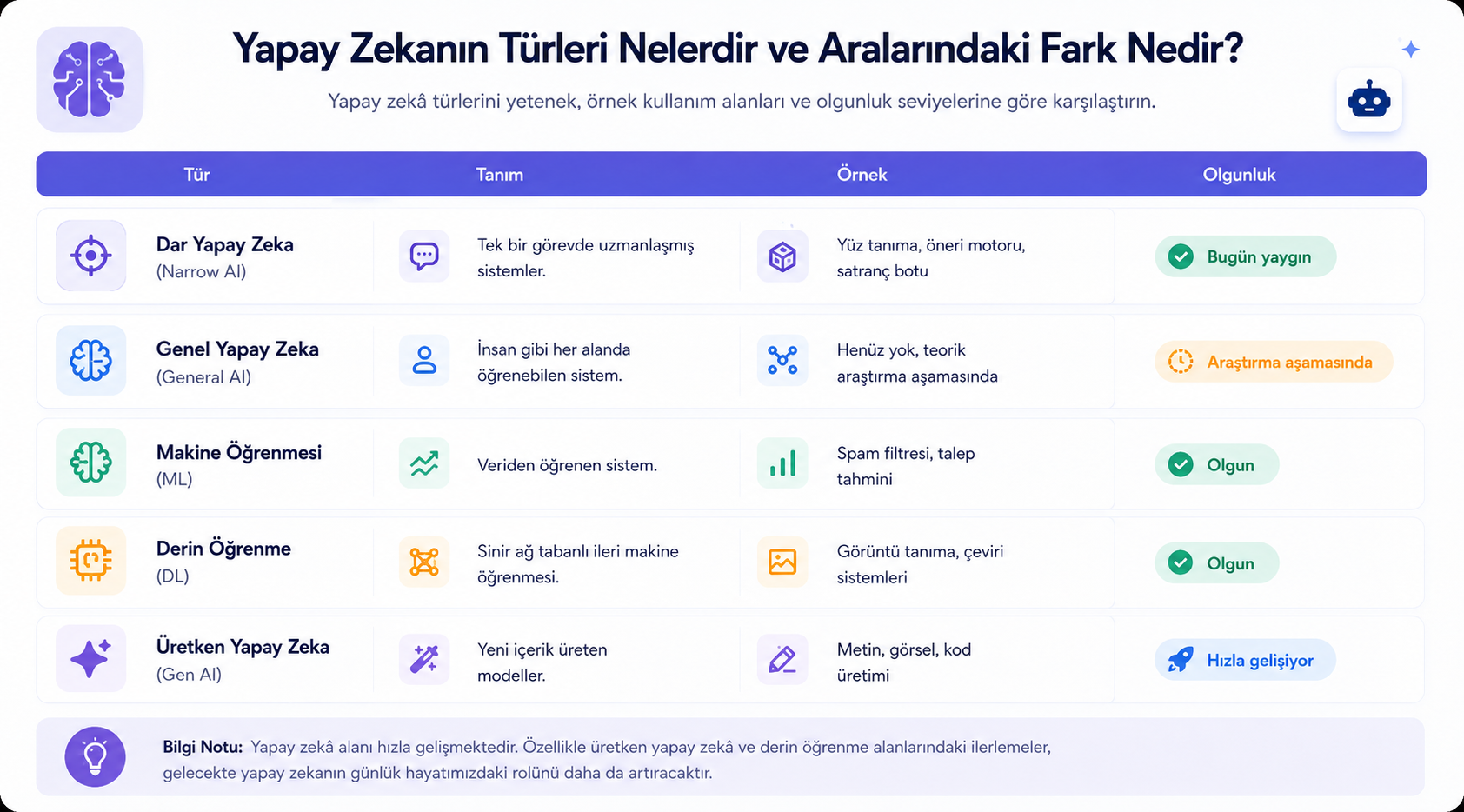
The most important distinction here is this: while machine learning and deep learning are methods, narrow and general AI are levels of capability. News reports claiming "AI has gained consciousness" refer to general AI, whereas all the tools we currently have are still within the boundaries of narrow AI.
What Should Be Considered When Using Artificial Intelligence?
The essence of using AI safely is not to trust its output blindly and to protect your data. The following six criteria serve as a checklist for both individual and corporate use.
- Data privacy and compliance: Do not enter sensitive personal or corporate data into public AI tools. Opt for enterprise versions that are compliant with regulations like GDPR and do not store your data for training purposes.
- Accuracy and hallucination checks: AI can generate false information that looks authentic (hallucinations). Always verify every output from an independent source before making critical decisions.
- Human oversight: Position AI as a decision-support tool, not the final decision-maker. In fields such as healthcare, law, and finance, final approval must always remain with a human.
- Bias and ethics: Models reproduce the biases present in the data they were trained on. Regularly audit results for fairness in processes such as hiring, lending, or performance evaluations.
- Over-reliance: Delegating every task to AI can weaken your own analytical thinking skills over time. Use the tool as an accelerator for your thinking, not a replacement for it.
- Legal liability: In most cases, the responsibility for content generated by AI lies with the user. Review it for copyright, accuracy, and regulatory compliance before publishing.
Why Is AI So Important Right Now?
AI is no longer a choice; it has become a standard part of competition. Renowned research clearly demonstrates the speed of this transformation.
According to McKinsey's 2025 State of AI report, more than three-quarters of organizations report using AI in at least one business function. This figure reveals how rapidly the technology has spread within just a few years.
The same research also includes an important caveat. While the vast majority of organizations use AI, the proportion of "high-performing" companies that generate measurable profit from it is around six percent. In other words, the real difference lies not in using AI, but in using it correctly.
At this point, it is necessary to separate the hype from reality. AI is not a magic tool that solves every problem; it is powerful for well-defined tasks but risky when used vaguely or without oversight. The definitions and types in this article are information that will remain valid for a long time, but since tools, models, and adoption rates change rapidly, we recommend updating this section at least once a year.
Frequently Asked Questions (FAQ)
Are AI and machine learning the same thing?
No. Machine learning is a subfield of AI. Every machine learning system is AI, but not every AI application uses machine learning.
Is the information I enter into AI tools safe?
It depends. Some public, free tools may use inputs for model training, so always check the tool's privacy policy and data retention settings before sharing sensitive information.
TL;DR
- AI is the general term for systems that learn from data by mimicking human intelligence.
- Its main branches are machine learning, deep learning, and generative AI.
- All current systems are narrow AI; artificial general intelligence does not yet exist.
- The six criteria for safe use: data privacy, accuracy, human oversight, bias, dependency, and legal liability.
- According to 2025 McKinsey data, most organizations are using AI, but only a minority are generating real value from it.
- The real difference lies not in using AI, but in using it correctly.
Conclusion
When structured correctly, AI is a powerful tool that saves time and improves decision quality; however, when left unchecked, it creates misinformation, data leaks, and ethical risks. The way to benefit from this technology is not to view it as a magic solution, but to use it consciously by protecting your data and verifying its output.
Audit the AI tools you are using or planning to use against the six safe-use criteria in this article. Start specifically with data privacy and human oversight; these two areas are the most frequently overlooked and carry the highest risk in both individual and corporate use.
Resources
- McKinsey, The State of AI (2025): https://www.mckinsey.com/capabilities/quantumblack/our-insights/the-state-of-ai
- TÜBİTAK Bilim Genç, Artificial Intelligence and Ethical Issues: https://bilimgenc.tubitak.gov.tr/makale/yapay-zeka-ve-etik-sorunlar-insanlik-teknolojinin-kontrolunu-kaybediyor-mu
İlginizi Çekebilecek Diğer İçeriklerimiz
A multi-LLM architecture is a system design that enables an organization to use multiple large language models simultaneously based on task type, rather than relying on a single model. Through model routing, observability, and fallback mechanisms, each query is directed to the most suitable model for that specific workload. The goal is to reduce vendor lock-in, optimize costs, and improve accuracy.
NaaS (Network as a Service) is a service model where businesses lease network services from a cloud provider via a subscription, rather than purchasing and managing their own network hardware. Functions such as firewalls, load balancing, VPNs, and WAN connectivity are delivered through software instead of hardware. This model transforms capital expenditure into operating expenses, making network infrastructure more agile and scalable.


