


AI-ready data is enterprise data that has been cleaned, made accessible, governed, and secured to the point where it can be safely used in the training and inference processes of artificial intelligence systems. For a dataset to be considered AI-ready, it is not enough for it to be accurate; it must also be accessible, consistently labeled, and compliant with regulatory requirements. AI projects deployed without meeting these conditions face risks related to accuracy, bias, and compliance.
Companies are investing millions of dollars in artificial intelligence, yet results often fall short of expectations. The reason for this is rarely the choice of model, but rather the state of the data feeding it. Because enterprise data accumulates in fragmented systems, inconsistent formats, and with poor governance, most AI projects fail to move past the pilot phase. This article breaks down the concept of AI-ready data into concrete criteria, a comparison, and an actionable roadmap for decision-makers.
What is AI-Ready Data?
AI-ready data is data that possesses the four fundamental qualities required for AI models to produce reliable outputs: unified accessibility, robust governance, security, and organizational support. Unlike the mere collection of raw data, this term refers to the final state of data that has been prepared for use.
Traditional data management focuses on the accurate storage and reporting of data. The AI-ready data approach goes a step further: it requires data to be presented in a consistent format—alongside unstructured content from different systems (PDFs, emails, images, messaging logs)—with traceable source information and access controls. This distinction is critical, as the vast majority of enterprise data remains unstructured.
Why Do Organizations Need AI-Ready Data?
A weak data foundation is the single biggest factor preventing AI projects from scaling. According to the 2024 IBM Institute for Business Value study, only 29% of technology leaders strongly agree that their enterprise data meets the quality, accessibility, and security standards required to scale generative AI.
This ratio indicates that most organizations face a significant gap between their AI strategy and their data infrastructure. As a result, many projects remain in the proof-of-concept stage or encounter unexpected errors when moved to production. The practical takeaway for decision-makers is this: a portion of the AI budget must be allocated to data preparation, not just model or tool selection.
When artificial intelligence is fed with the right data, three tangible benefits emerge. More accurate predictions and recommendations are generated because the model is not trained on noisy or contradictory inputs. Compliance risk is reduced because the data source and processing workflow are traceable from the start. New AI projects are deployed faster because the need to re-clean data for every project is eliminated.
How Do You Know If Your Data Is AI-Ready?
To evaluate whether a dataset is AI-ready, four areas must be checked: accessibility, governance, security, and organizational support. The table below summarizes the key differences between the traditional data management approach and the AI-ready data approach.
Comparison of Traditional Data Management and AI-Ready Data Management
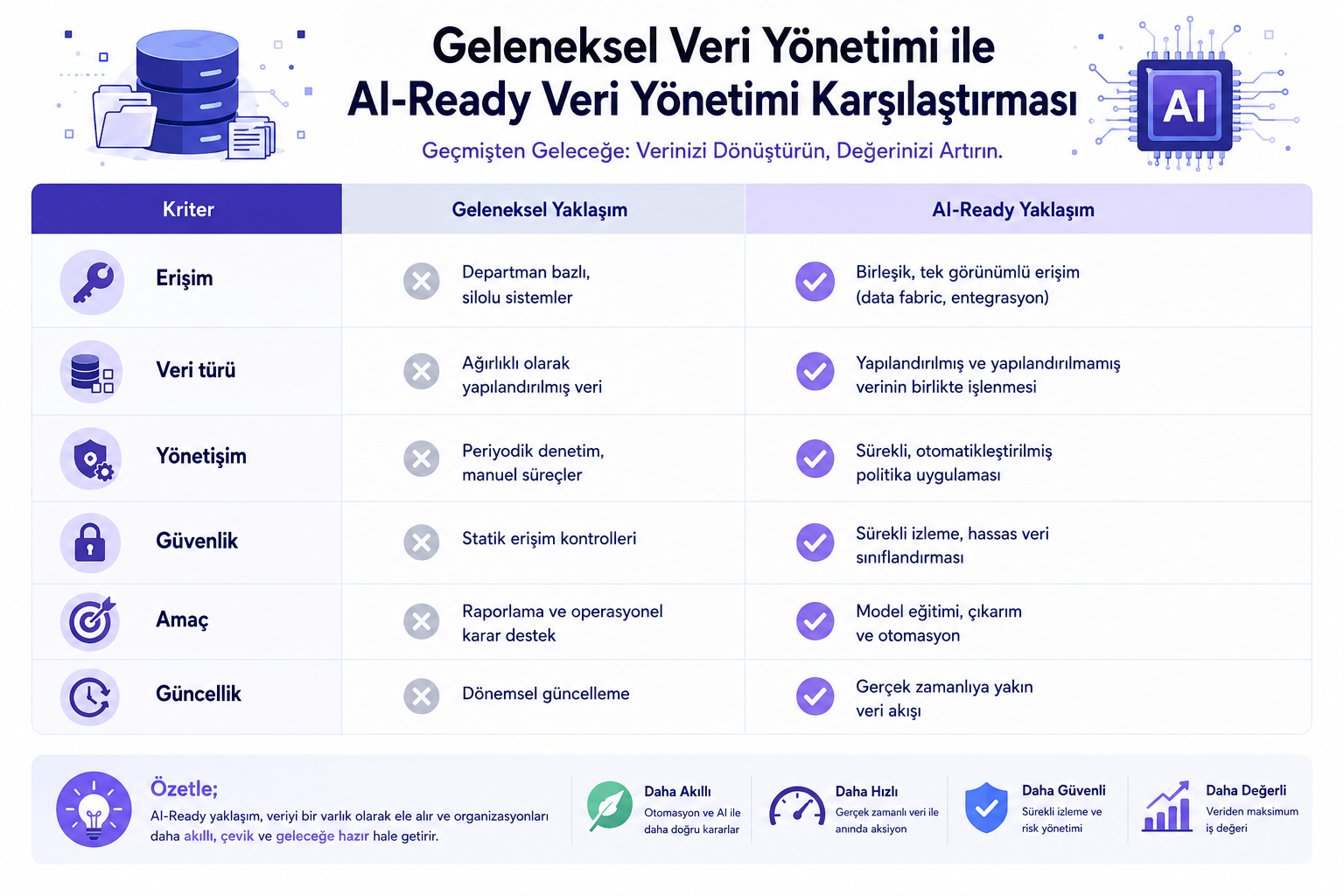
This table can also be used as a self-assessment tool. If an organization is still on the left side for most of the columns, it means it needs to review its data infrastructure before investing in artificial intelligence.
What Obstacles Arise on the Path to AI-Ready Data?
Four obstacles appear repeatedly: data fragmentation, poor data quality, security and governance gaps, and a lack of expertise. Being aware of these obstacles makes budget and time planning more realistic.
Data fragmentation and silos stem from organizational structure and the accumulation of different systems over time. When a customer record in the CRM is kept one way and in the billing system another way, this inconsistency is carried over to the AI model. To solve this, one must first create a data catalog that shows where which data lives, and then consolidate critical data fields.
Poor data quality is fueled by legacy systems, inconsistent entry standards, and integration issues. The International Data Corporation (IDC) reveals that less than 1% of enterprise unstructured data is in a format directly suitable for AI use. Therefore, data quality work should be planned as a prerequisite that precedes model selection.
Security and governance risks grow because sensitive data is scattered across multiple systems. Organizations must first discover and classify sensitive data, then establish access controls accordingly. The skills gap is often overlooked; bottlenecks occur when data teams are forced to both manage existing systems and prepare data for AI projects simultaneously.
How Do Organizations Build AI-Ready Data?
The correct sequence is to first resolve fundamental data quality issues, then establish a governance and access layer. The decision framework below clarifies which stage an organization should start from.
Situations where you should focus on fundamental data quality first: If the organization lacks a data catalog, has a high rate of missing or conflicting records in critical data fields, or if it is unclear which data resides in which system. In this case, data cleaning, standardization, and cataloging must be prioritized before starting an AI project. Otherwise, the model will be trained on poor-quality data and produce misleading results.
Situations where you can transition to an AI-ready transformation: If the organization already has robust data governance, defined access controls, and operational data quality processes, the next step is to build a unified access layer (data integration or data fabric architecture) and incorporate unstructured data into the same governance framework as structured data. Starting with a pilot AI project at this stage is the lowest-risk way to test the process with live data.
In both cases, the first concrete step is the same: create an inventory of existing data sources and score each source in terms of accessibility, quality, security, and currency.
Frequently Asked Questions
What is the difference between AI-ready data and big data? Big data is about volume and variety; AI-ready data is about how usable that data is. A massive dataset is not considered AI-ready if it is scattered and inconsistent. What matters is not volume, but that the data is verified, accessible, and traceable.
How long does the transition to AI-ready data take? The duration depends on the organization's current data maturity; it may take a few months for organizations with robust data governance, and over a year for those with siloed and fragmented data structures. Instead of a comprehensive transformation, starting with the most critical data areas first will shorten the timeline.
Is AI-ready data necessary for small and medium-sized companies? Yes, it is necessary regardless of scale; because a model trained on bad data will produce incorrect results in a small company just as it would in a large one. The advantage for small companies is that they can complete the transformation faster because they deal with fewer systems.
Does AI-ready data only cover structured data? No, unstructured data (documents, emails, images, audio recordings) is also included and makes up the majority of corporate data. Since modern AI applications, especially generative AI, can use this unstructured data meaningfully, ignoring it leads to a significant loss of opportunity.
TL;DR:
- AI-ready data is data that possesses four fundamental qualities: accessibility, governance, security, and organizational support.
- Only 29 percent of technology leaders believe their corporate data is ready to scale AI.
- The biggest obstacles are data fragmentation, low data quality, security vulnerabilities, and a lack of expertise.
- The correct sequence is to first fix data quality, then establish a unified access and governance layer.
- Less than 1 percent of corporate unstructured data is currently ready for direct AI use.
Conclusion
AI-ready data is not a technology trend; it is a fundamental prerequisite that determines whether an AI investment will yield a return. No matter how accurate the model selection is, if it is built on a foundation of fragmented and low-quality data, the project will not move past the pilot stage. For decision-makers, the real difference lies not in choosing the right tools, but in prioritizing data preparation before model selection.
As a first step, score your organization's critical data sources according to the six criteria in the table above and determine which column you are concentrated in. This assessment will clearly reveal where you should start for your next AI project.
Resources:
- IDC, "Untapped Value: What Every Executive Needs to Know About Unstructured Data", August 2023
İlginizi Çekebilecek Diğer İçeriklerimiz
A multi-LLM architecture is a system design that enables an organization to use multiple large language models simultaneously based on task type, rather than relying on a single model. Through model routing, observability, and fallback mechanisms, each query is directed to the most suitable model for that specific workload. The goal is to reduce vendor lock-in, optimize costs, and improve accuracy.
NaaS (Network as a Service) is a service model where businesses lease network services from a cloud provider via a subscription, rather than purchasing and managing their own network hardware. Functions such as firewalls, load balancing, VPNs, and WAN connectivity are delivered through software instead of hardware. This model transforms capital expenditure into operating expenses, making network infrastructure more agile and scalable.


